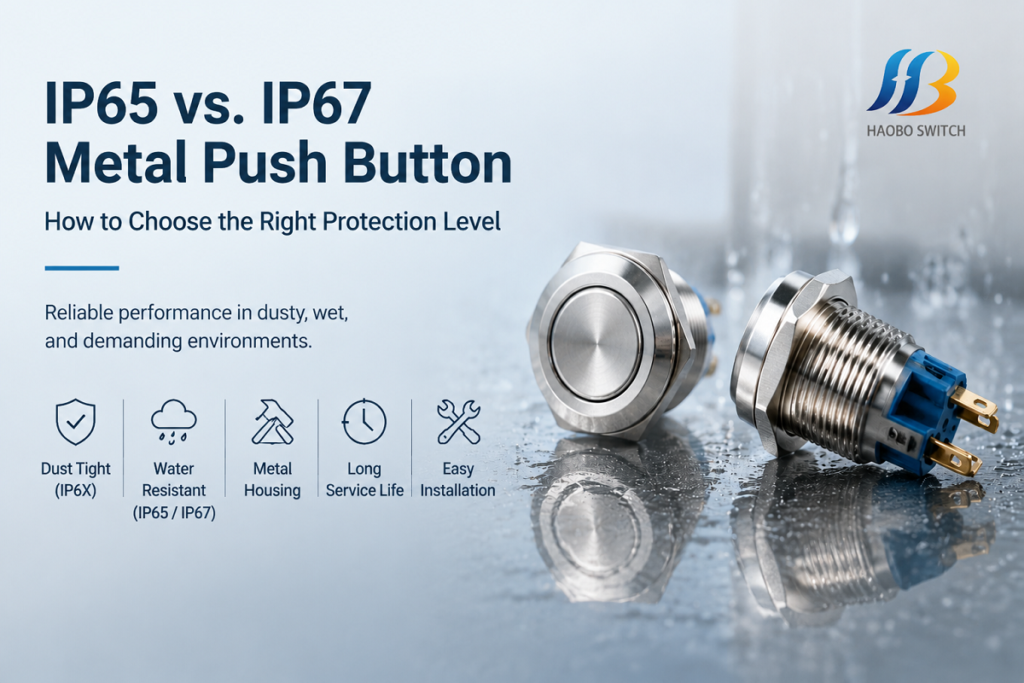
IP65 Metal Push Button vs. IP67 Metal Push Button: How to Choose the Right Protection Level
Why IP Protection Matters
Metal push buttons are widely used in industrial control panels, access control systems, charging equipment, food machines, outdoor devices, and automation systems. In these applications, dust, rain, splashing water, cleaning moisture, and temporary water exposure may affect performance.
An IP65 Metal Push Button and an IP67 Metal Push Button both provide dust-tight protection, but they are tested under different water conditions. The correct choice should be based on the actual environment, installation method, and enclosure design.
Understanding IP65 and IP67
IP ratings are defined by IEC 60529. The first digit describes protection against solid objects and dust, while the second digit describes protection against water.
For both IP65 and IP67, the first digit is 6, indicating dust-tight protection. The difference is in the water test.
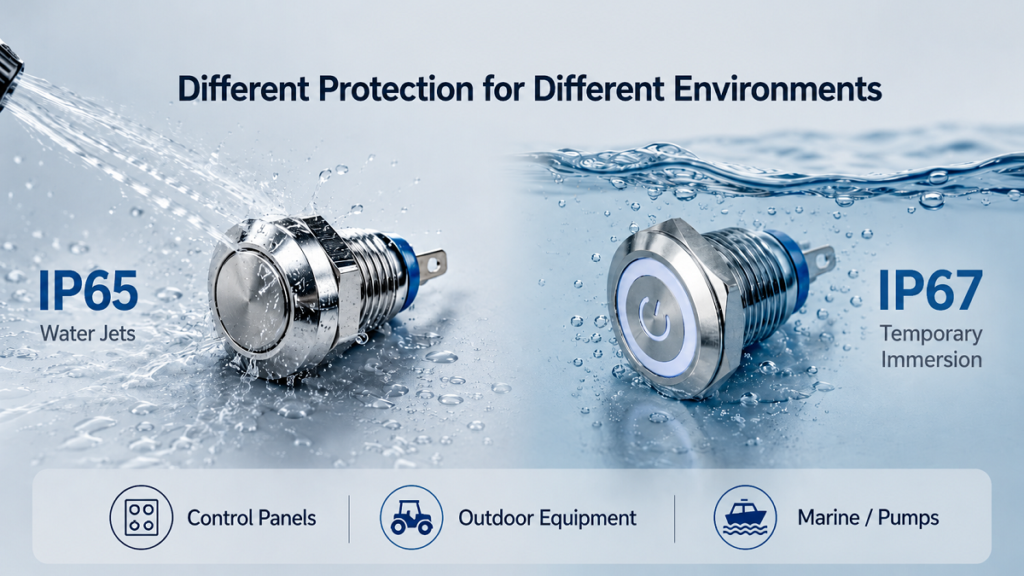
An IP65 Metal Push Button is tested against water jets under specified conditions. An IP67 Metal Push Button is tested for temporary immersion under specified conditions.
These are different test categories. An IP67 rating does not automatically prove that the same product has passed the IP65 water-jet test. If a product has been tested for both conditions, the manufacturer may state both ratings, such as IP65/IP67.
IP67 also does not mean that a button can remain underwater indefinitely or withstand every high-pressure washdown condition.
When to Use an IP65 Metal Push Button
An IP65 Metal Push Button is suitable for equipment exposed to dust, rain, splashing water, or water jets, where temporary immersion is not expected.
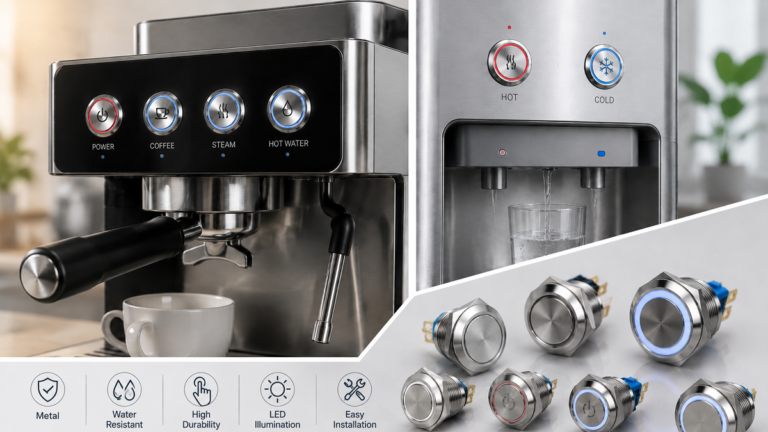
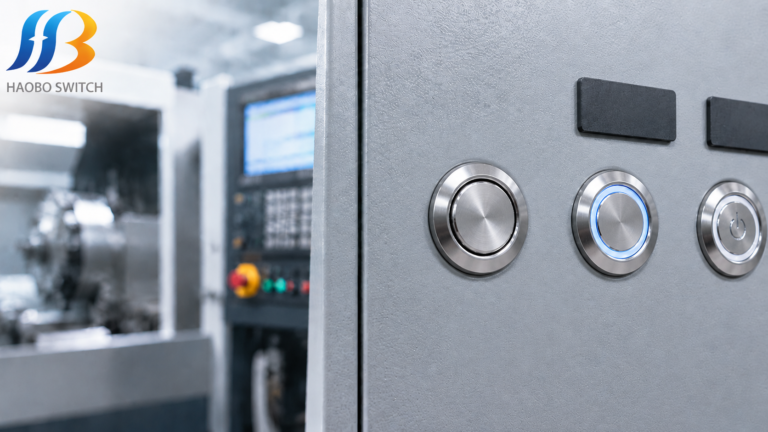
Typical applications may include industrial control panels, factory machinery, access control equipment, coffee machines, water dispensers, and covered outdoor control boxes.
For these applications, an IP65 push button can provide a practical balance between protection, cost, and installation requirements.
However, the rating may apply only to the front of the button after correct panel installation. Rear terminals, cable connections, and the enclosure may have a different protection level.
When to Use an IP67 Metal Push Button
An IP67 Metal Push Button is more suitable when temporary immersion is a realistic risk. This may occur in outdoor installations, low-lying areas, or equipment briefly exposed to standing water.
Possible applications include outdoor access systems, outdoor control cabinets, selected agricultural equipment, and charging stations exposed to wet conditions.
For marine, coastal, agricultural, or highly humid environments, buyers should also confirm corrosion resistance, material grade, operating temperature, terminal protection, and enclosure design.
An IP67 push button should not be selected simply because the number is higher. For rain, water jets, or washdown exposure, buyers should confirm the required jet-protection rating separately.
Installation Determines Final Protection
The final protection performance depends on the complete installation, not only on the button label.
The panel should be flat, clean, and free from burrs or deformation. The mounting-hole diameter must match the product drawing, and the sealing ring should contact the panel evenly.
An O-ring or sealing gasket, together with a correctly tightened mounting nut, can help reduce water and dust entry through the panel opening. Insufficient tightening may reduce sealing performance, while excessive force may damage the gasket, thread, housing, or panel.
Rear terminals, cable entries, connectors, wiring, and enclosure joints also require suitable protection. Buyers should confirm whether the IP rating applies to the front of the mounted button, the complete button body, or the assembled enclosure.
After installation, the complete panel should be tested under conditions that reflect the actual application.
Material and Environmental Requirements
IP protection describes resistance to specified dust and water conditions. It does not automatically confirm corrosion resistance, impact resistance, temperature performance, or electrical capacity.
Metal push buttons may be made from stainless steel, nickel-plated brass, aluminum alloy, or other materials. Stainless steel is commonly selected for industrial panels, outdoor equipment, food machines, and public control devices.
Different stainless steel grades may provide different levels of corrosion resistance. Equipment used in coastal areas, chemical environments, or locations with high humidity may require additional material and surface-treatment evaluation.
Other Specifications to Confirm
In addition to the IP rating, buyers should check:
- Momentary or latching operation
- Normally open, normally closed, or combined contacts
- Rated voltage and current
- LED voltage and color
- Mounting-hole diameter and panel thickness
- Terminal type and wiring method
- Housing material and operating temperature
- Mechanical life, impact, and corrosion requirements
These parameters determine whether the selected IP65 Metal Push Button or IP67 Metal Push Button is suitable for the equipment.
How to Choose the Correct Protection Level
Choose an IP65 Metal Push Button when the application requires dust-tight construction and protection against rain, splashing water, or water jets, without a realistic risk of temporary immersion.
Choose an IP67 Metal Push Button when temporary immersion may occur under the specified test conditions.
If the equipment may face both water jets and temporary immersion, confirm that the product has been tested and rated for both conditions.
The final decision should be based on actual water exposure, installation position, panel design, terminal protection, material, temperature, and enclosure performance.
Conclusion
An IP65 Metal Push Button and an IP67 Metal Push Button address different water-exposure conditions.
IP65 is mainly associated with water-jet protection, while IP67 is associated with temporary immersion. Neither rating should be interpreted beyond its specified test conditions.
By checking the actual environment, sealing structure, wiring protection, material, and electrical parameters, manufacturers can select a metal push button that provides reliable protection without unnecessary cost or incorrect assumptions.