What Is an Anti-Vandal Switch? Types, Features, and Applications
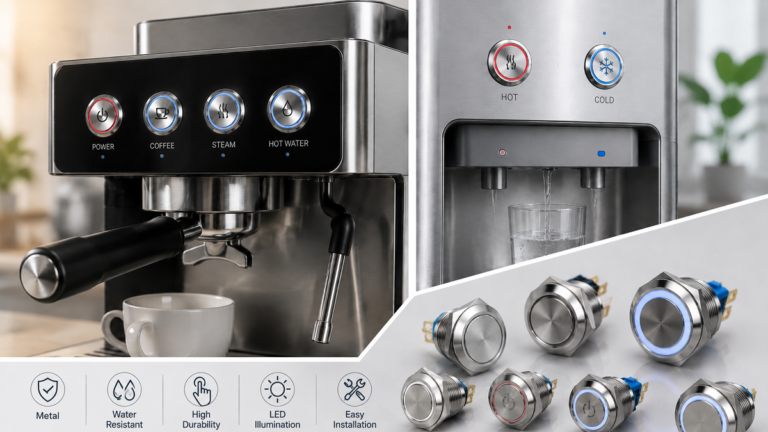
Anti-vandal switches are widely used in access control systems, industrial machinery, electric vehicle charging stations, vending machines, elevators, self-service terminals, and outdoor control panels. They provide a durable way to start, stop, reset, confirm, or change equipment functions from a panel.
Understanding how an anti-vandal switch works helps engineers, equipment manufacturers, distributors, and buyers select a suitable model according to its installation dimensions, operating method, contact configuration, electrical requirements, and working environment.
Although many anti-vandal switches have a similar metal appearance, their internal structures and technical specifications may differ. Buyers should therefore check the operating type, contact arrangement, LED voltage, terminal style, housing material, mounting size, and IP protection level before ordering.
What Is an Anti-Vandal Switch?
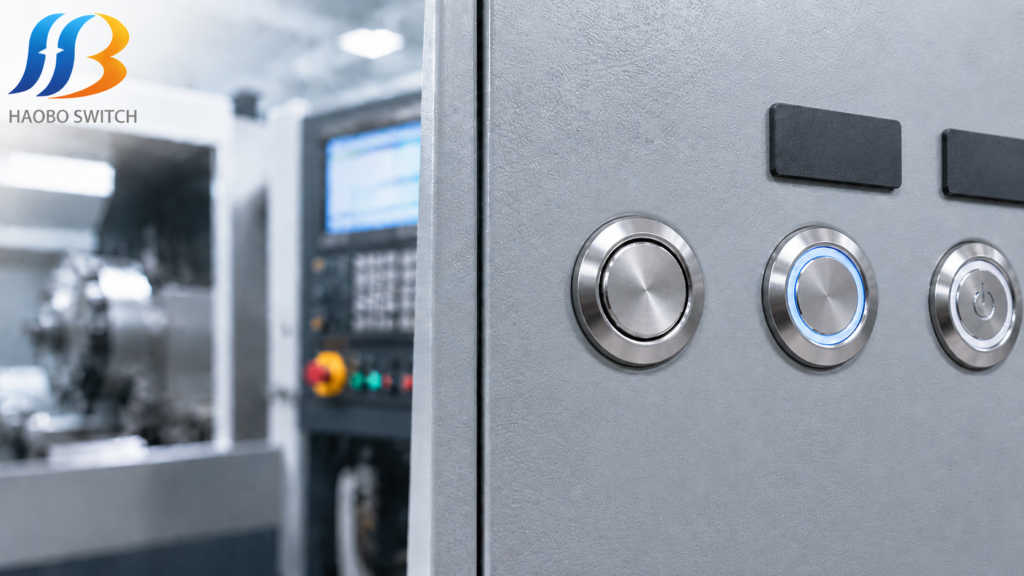
An anti-vandal switch is a mechanically robust electromechanical switch designed for equipment that may be exposed to frequent operation, accidental impact, attempted tampering, public use, or demanding environmental conditions.
A typical anti-vandal push button switch may include:
- A metal actuator
- A metal bezel or threaded housing
- An internal operating mechanism
- Electrical contacts
- Connection terminals
- A mounting nut
- A sealing ring
Illuminated models may also include an LED module with ring, dot, or power-symbol illumination. Laser-etched or customized symbol options may also be available, depending on the product series and manufacturer.
Compared with many standard plastic buttons, the metal construction generally provides greater mechanical strength, improved wear resistance, and a cleaner industrial appearance. Stainless steel and other corrosion-resistant materials may also improve performance in outdoor or industrial environments.
However, the term “anti-vandal” does not mean that the switch is completely indestructible. It normally describes a robust switch designed to withstand frequent use, attempted tampering, and accidental impact.
Buyers should still confirm the mechanical specifications, electrical ratings, installation requirements, IP protection level, and applicable certifications before selecting a product.
The metal housing does not determine the electrical capacity of the internal contacts. Rated voltage, rated current, load type, and switching performance must be checked according to the product datasheet.
How Does an Anti-Vandal Switch Work?
When the button is pressed, the internal mechanism changes the position of the electrical contacts. Depending on the contact arrangement, the circuit may open, close, or switch between different states.
A normally open contact, marked NO, remains open when the button is not being operated. When the user presses the button, the contact closes and allows current or a control signal to pass.
NO contacts are commonly used for:
- Door-release commands
- Machine start functions
- Reset and confirmation signals
- PLC inputs
- Call buttons
- Equipment activation
A normally closed contact, marked NC, remains closed in its normal position and opens when the button is pressed.
NC contacts may be used for:
- Ordinary stop commands
- Monitoring circuits
- Alarm circuits
- Interlock control
- Equipment status detection
Some anti-vandal push button switches provide a 1NO1NC contact arrangement. This allows one button operation to change the states of both the normally open and normally closed contacts.
The operating method and contact configuration are separate specifications. A momentary switch may use NO, NC, or combined contacts. A latching switch may also be manufactured with different contact arrangements.
Momentary and Latching Anti-Vandal Switches
A momentary anti-vandal switch changes its contact state only while the button is being pressed. After the user releases it, an internal spring returns the actuator and contacts to their original positions.
Momentary models are commonly used for:
- Access control door release
- Elevator call buttons
- Machine start and ordinary stop commands
- Reset and confirmation functions
- Self-service terminals
- Public-use control panels
- PLC and relay signal inputs
In some control systems, the equipment may continue operating after the button is released. In this case, a PLC, relay, contactor, timer, or electronic controller maintains the operating state rather than the switch itself.
A standard anti-vandal push button should not automatically be treated as an emergency-stop device. Safety-related emergency-stop functions normally require a dedicated emergency-stop switch specifically designed, tested, and approved for that purpose.
A latching anti-vandal switch, also called a maintained switch, keeps its changed mechanical position or contact state after the button is released.
A common push-on, push-off design changes state after the first press and returns to its original state after the second press.
Latching models are often used for:
- Equipment power control
- Lighting control
- Manual ON/OFF functions
- Control panel mode selection
- Small electronic devices
- System activation and deactivation
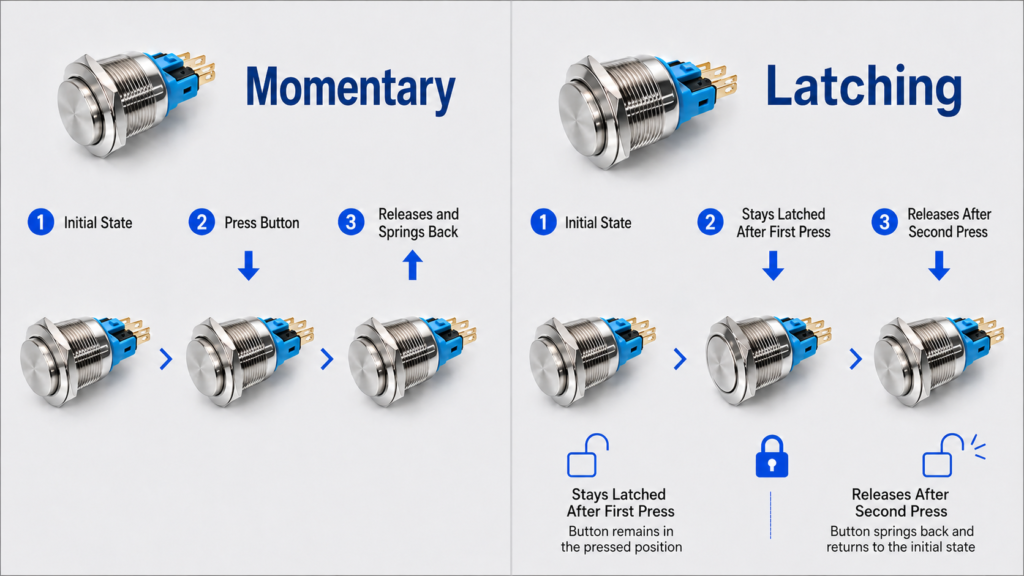
The correct operating type depends on whether the equipment requires a temporary command or a maintained switching state.
Contact, LED, and Terminal Options
An anti-vandal switch may be available with NO, NC, 1NO1NC, or other contact arrangements. The correct configuration should follow the equipment wiring diagram and control logic.
An illuminated anti-vandal switch combines electrical switching with visual status indication.
Common illumination styles include:
- Ring illumination
- Dot illumination
- Power-symbol illumination
- Laser-etched or customized symbols, depending on the product series
Common LED colors include red, green, yellow, blue, and white.
The LED color should match the equipment status logic. For example, red may indicate a fault or alarm, green may indicate normal operation, and yellow may represent a warning or condition requiring attention.
The exact meaning of each color should follow the equipment design, customer requirements, and relevant industry standards.
Depending on the product structure and wiring method, the LED may indicate:
- Power ON status
- Button activation
- Machine running status
- Door-release status
- Alarm conditions
- A PLC-controlled signal
The LED circuit and switching contacts may have different electrical requirements. For example, the contacts may switch one circuit voltage while the LED uses a separate AC or DC power supply.
Buyers should therefore confirm both the contact rating and the LED voltage before ordering.
Common terminal options include solder terminals, screw terminals, plug-in terminals, pin terminals, and pre-wired leads. The correct terminal type depends on the assembly method, available wiring space, maintenance requirements, and production process.
Materials, Mounting Sizes, and Protection
Common anti-vandal switch materials include stainless steel, nickel-plated brass, aluminum, and other coated metal alloys.
A stainless steel anti-vandal switch is commonly selected for applications requiring mechanical strength, wear resistance, corrosion resistance, and a professional industrial appearance.
Nickel-plated brass provides good machinability, mechanical strength, surface appearance, and a practical balance between performance and cost.
Aluminum is lightweight and may be suitable for applications requiring reduced weight, anodized colors, or a particular surface finish.
Depending on the product series, common mounting hole sizes may include:
- 12 mm
- 16 mm
- 19 mm
- 22 mm
- 25 mm
Larger mounting sizes may also be available, depending on the product series and manufacturer.
The mounting diameter is not the only installation factor. Buyers should also check:
- Panel thickness
- Thread length
- Button body depth
- Head diameter
- Terminal position
- Available space behind the panel
Two products with the same mounting diameter may still have different body lengths, thread lengths, terminal layouts, or sealing structures.
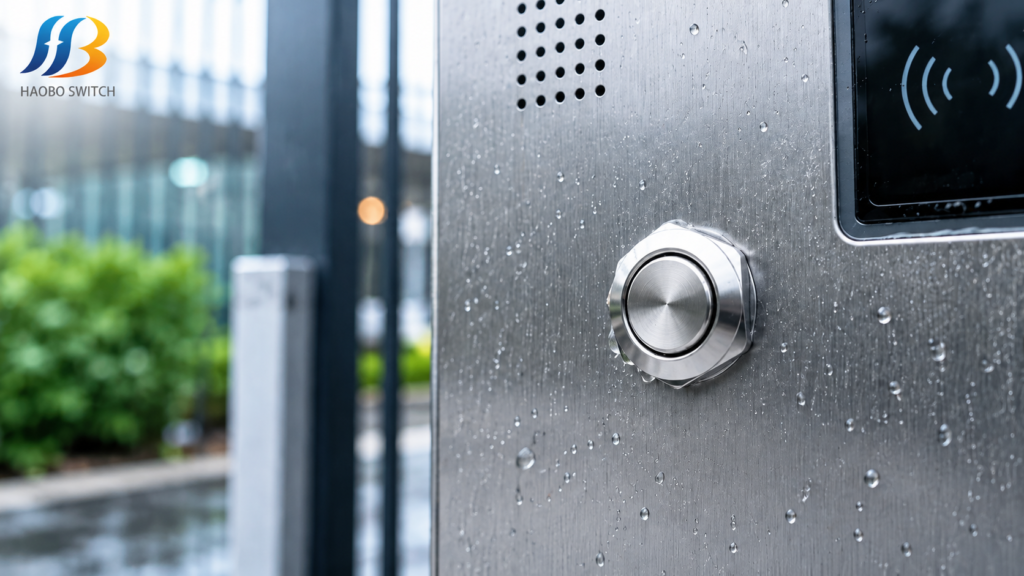
For applications exposed to water, dust, oil, cleaning processes, or outdoor conditions, a waterproof anti-vandal switch may be required.
For many panel-mounted switches, the stated IP protection level mainly applies to the installed front side. Unless the datasheet clearly specifies full-body protection, buyers should not assume that the rear housing, terminals, and wiring connections have the same IP rating as the installed front side.
Correct installation is also important. The sealing ring should be undamaged, the panel hole should match the specified dimensions, and the mounting nut should be tightened correctly.
Common Applications
Anti-vandal switches are commonly used in:
- Access control and door-release systems
- Industrial machinery
- Automation control panels
- Electric vehicle charging stations
- Elevators and public call panels
- Vending and ticket machines
- Parking systems
- Outdoor control equipment
- Self-service terminals
- Public-use control panels
- Building automation systems
These applications often require a strong panel-mounted switch that can withstand frequent operation while maintaining a clean and professional appearance.
However, not every anti-vandal switch is suitable for every type of equipment.
For elevators, transportation systems, medical equipment, charging equipment, and other regulated applications, the selected product must also meet the relevant electrical, mechanical, environmental, and certification requirements.
The same external design may be available with different operating methods, contact arrangements, LED voltages, terminal styles, materials, and IP ratings. Product selection should therefore be based on technical specifications rather than appearance alone.
How to Choose the Correct Anti-Vandal Switch
Before requesting a quotation or ordering samples, buyers should confirm:
- Mounting diameter and panel thickness
- Available installation depth
- Momentary or latching operation
- NO, NC, or combined contacts
- Rated voltage and rated current
- AC or DC circuit
- Electrical load type
- LED voltage and color
- Illumination style
- IP protection requirement
- Housing material
- Terminal type
- Indoor or outdoor environment
- Certification requirements
The actual load type is particularly important. A contact rating specified for a resistive load may not be suitable for the same current under an inductive, capacitive, motor, or lamp load.
For motors, heaters, solenoids, electromagnetic locks, and other demanding loads, the switch may need to control a relay, contactor, PLC input, or electronic control module instead of switching the main load directly.
Providing complete application information helps the anti-vandal switch manufacturer recommend a suitable model. It also reduces the risk of installation problems, wiring errors, unsuitable electrical loads, and operating failures.
Conclusion
Understanding what an anti-vandal switch is provides a practical foundation for product selection.
An anti-vandal switch generally offers a stronger and more durable structure than many conventional panel buttons. However, the term does not mean that the product is indestructible or suitable for every safety-related application.
A suitable switch must fit the equipment panel, match the required control logic, meet the electrical specifications, and withstand the actual operating environment.
Selecting the correct operating method, contact configuration, LED specification, housing material, IP protection level, terminal type, and installation size is essential for reliable long-term performance.